Sunday, December 2, 2018

Is Indonesian Islam too big to fail?

Syafiq Hasyim
Director of the International Center for Islam and Pluralism in Jakarta
Jakarta   /   Fri, June 9, 2017   /  11:44 am
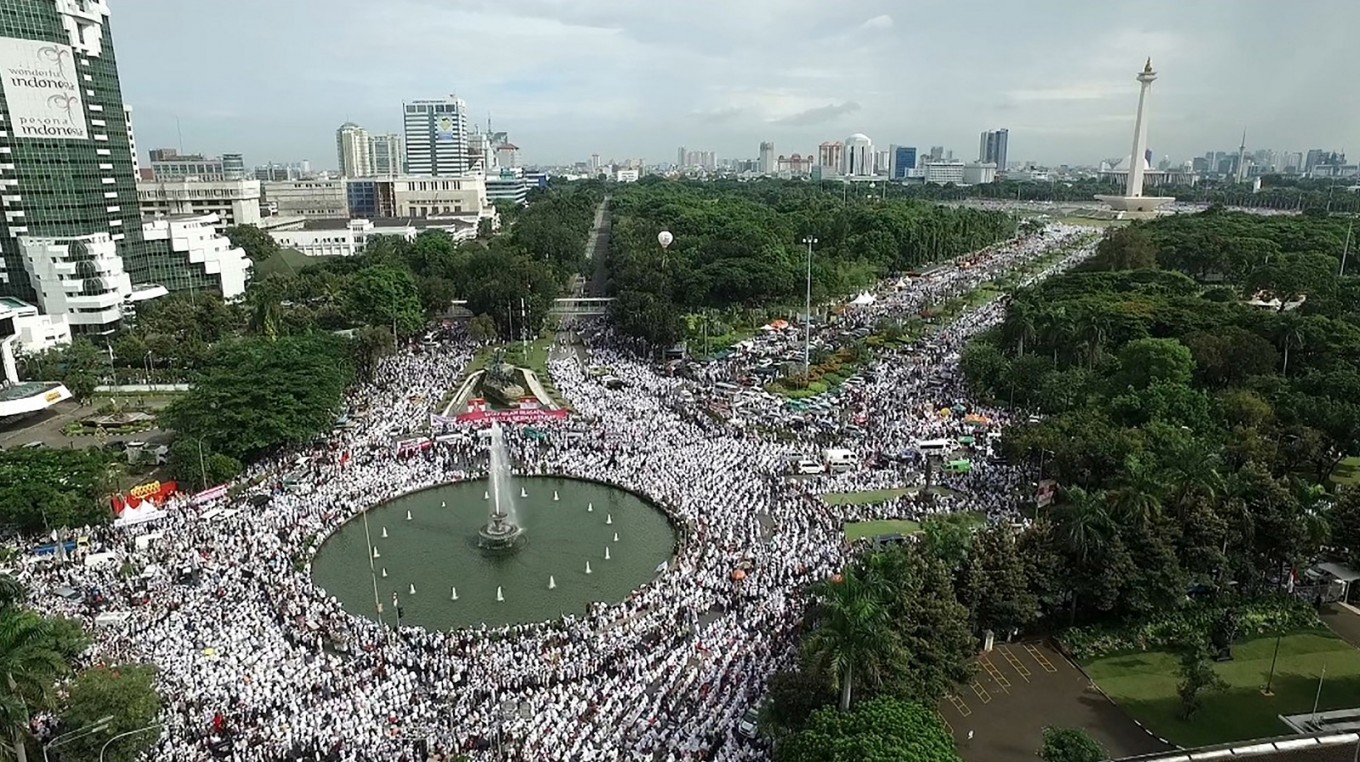
This aerial view shows Indonesian Muslims gathering at Jakarta's National Monument Park as part of a rally against Jakarta's Christian Governor Basuki Tjahaja Purnama, better known by his nickname Ahok, on December 2, 2016. More than 100,000 Indonesian Muslims protested on December 2 against Jakarta's Christian governor, the second major demonstration in a matter of weeks as conservative groups push for his arrest on accusations of insulting Islam. (AFP/File)

The above question is addressed to those who still believe in the strength of Indonesian Islam post-Jakarta gubernatorial election and the verdict of two years’ imprisonment handed down to Basuki “Ahok” Tjahaja Purnama, the outgoing Jakarta governor.
Indonesian Islam refers to Islam that is progressive, moderate and respectful of the diversity of ethnicities, beliefs and cultures that support democracy in the country.
For many years, local and international observers have felt confident about the authority of Indonesian Islam. The mushrooming of Islamic conservatism and radicalism has not been considered threatening enough to shrink the dominance of moderate and inclusive Islam.
The dominant role of the largest Islamic organizations, Nahdathul Ulama (NU) and Muhammadiyah, in Muslim communities is often used as reason for this optimism. Is this thesis still valid?
Indonesian Islam has been socially and politically attempted and strived for by those who believe in compatibility between Islam and democracy.
However, many elements of Indonesian Islam are too self-confident about the long supremacy of Indonesian Islam.
The source of this conviction is often the history of Islam’s entry to this country. It is often said Islam in Indonesia is different from Islam in the Middle East owing to its historical process, which was not through war and bloodshed but through peaceful penetration.
Thus, many of us take for granted and feel satisfied that the progressive and moderate characteristics of Indonesian Islam would never be defeated by the different version of Islam in this country.
Such historical evidence is very important, however not enough to maintain and sustain Indonesian Islam. It is questionable and to some extent no longer relevant.
Now, Indonesian Islam has begun to lose ground on account of an aggressive counter from “the different version of Islam” — stemming from the tendency of especially urban folks demanding an Islam that is more ideological, formalistic and operational in politics. More Indonesian Muslims want Islam as their main identity in politics, culture and lifestyle.
This tendency had been detected long before the 2017 Jakarta gubernatorial election, although many of us apparently ignored it. Many attempts at “sharia-zation” (inclusion of sharia in the legal, political and public sphere) has run systematically and strategically since the Reform Era.
When attempts aimed to make Indonesia a sharia-based state failed in 2002, the strategy of the sharia movement turned into a cultural movement, by conditioning Indonesian Muslims to embrace more sharia-inspired lifestyles such as halal economics and consumption.
Indonesia now has the 2014 law on halal product assurance as well as the 2008 law on sharia banking.
The halal and sharia economic movement is a step further toward the establishment of sharia as the legal and political system. Its propagators use a direct connection strategy to the grass roots, including through social media.
Its messages stimulate emotions of being Muslim, including the social gap and injustice experienced by many Muslims.
At a different level, the propagators of Indonesian Islam are not really aware of and to some extent dismiss this new environment and contestation in coining the meaning of Islam. Such “progressive” Muslims seem to be ignorant and overconfident.
The NU and Muhammadiyah, which are expected to be bastions of moderate Indonesian Islam, have been too busy bargaining for power in the government, and care less for their communities.
In addition, both organizations rely heavily on the state for being the guardians of sustainability of democracy and benign Islam.
Sometimes, the NU is very critical of the antidemocratic movement, but theirs are often lone voices. In short, the consolidation of Indonesian Islam tends to indicate their failure.
Interestingly, those who need “more formalistic, ideological and political Islam” are intensively mingled with populist issues. They have shown adequate flexibility to blend their campaigns with issues of social and economic injustice.
Although religious sentiment remains very important for their movement, the groups have indicated their ability to consolidate networks and to gain a stronger grip on the Muslim grass roots.
Combining populism with identity based politics has been very successful, as indicated by two results; first, the loss of Ahok-Djarot Saiful Hidayat in the recent Jakarta election and second, their pressure on Ahok’s trial that resulted in a two-year sentence for blasphemy.
What should be done by Indonesian Islam to overcome this circumstance?
Indonesian Islam should not mimic the strategy used by those who believe in Islamic formalism, ideology and politics.
For instance, using populism as the tagline of its struggle would lead to tyranny by the majority. Indonesian Islam instead aims for reduced segregation between the majority and minority.
Indonesian Islam should not use identity politics because doing so could lead to discrimination. Unfortunately, reflecting on the recent Jakarta gubernatorial election, today’s Indonesian Muslims in general seem to love both populism and identity politics.
In fact, Ahok’s case has stimulated the sentiment of Islamic populism and identity politics. Indonesian Muslims who have been recognized as open and tolerant are becoming more ethnic and religion-oriented.
If Indonesian Islam does not want to fail in mainstreaming its religious discourse, it must find ideas and idioms that can regain cleverly and responsibly the support of Indonesian Muslims.
If not, the notion that Indonesian Islam is too big to fail is just a claim.
Disclaimer: The opinions expressed in this article are those of the author and do not reflect the official stance of The Jakarta Post.

https://www.thejakartapost.com/academia/2017/06/09/is-indonesian-islam-too-big-to-fail.html

Tuesday, November 20, 2018

Thursday, November 8, 2018

Kasman Singodimejo: Santri Nasionalis Berkemajuan

Kasman Singodimejo: Santri Nasionalis Berkemajuan


Dār al-‘Ahd wa al-Shahādah: Muhammadiyah’s Contemporary Ijtihād of Siyar and Pancasila

Bachtiar, Hasnan. 2018. Dār al-‘Ahd wa al-Shahādah: Muhammadiyah’s Contemporary Ijtihād of Siyar and Pancasila. MA Thesis, College of Arts and Social Sciences, The Australian National University.

Abstract

This thesis examines the concept of Siyar that has been developed by Muhammadiyah, especially in the context of nation-state, globalisation, and the post-9/11 and post- reformation era of Indonesia. In 2015, Muhammadiyah proclaimed the notion of Negara Pancasila sebagai Dār al-‘Ahd wa al-Shahādah, which means the state of Pancasila as the state of consensus and witness, as a representation of the Siyar. This thesis fills three gaps of study: first, Siyar, which has been developed in the Arab- Islamic traditions, has not been studied in the context of Southeast Asia, and especially Indonesia, a non-Arab country with the largest Muslim population; second, academic works on the specific topic of Muhammadiyah produced in Western universities have not discussed the Muhammadiyah’s view of Siyar; and third, the studies that have focused on Siyar have not yet dealt with discourse on contemporary Indonesian politics and especially Muhammadiyah’s place in it.

This thesis combines library research, and social and historical contextualisation. This combination relies on primary sources consisting of official documents of Muhammadiyah, academic and intellectual works of its elites and research publications, and secondary sources that consist of scholarly works on the specific issue of the Muhammadiyah conceptualisation under study. This analysis is supported by interviews with key persons in Muhammadiyah elites who have contributed to the development of the notion of Negara Pancasila sebagai Dār al-‘Ahd wa al-Shahādah.

The thesis finds that Muhammadiyah conceptualises the notion of Negara Pancasila sebagai Dār al-‘Ahd wa al-Shahādah as an intellectual reconciliation between the state ideology of Pancasila and the doctrine of Siyar. This notion is based on its fundamental basis of thought called Islam Berkemajuan (progressive Islam), whereby Islam should be viewed progressively as a problem-solving religion. This effort, in Muhammadiyah’s perspective, is ijtihād which primarily aims to solve the problem of the significant spread of conservative and radical Islamism. In its view, this problem can potentially lead to national disintegration since the Islamists have questioned the status of Indonesia as a state (because it is not dar al-Islam or an Islamic state) and its political system (it is not a Sharī‘ah system). In this context, Muhammadiyah argues that Indonesia is the state based on Pancasila (Negara Pancasila), and since Pancasila was conceptualised through the national consensus by its founding fathers, Indonesia should be understood as the state of consensus (dār al-‘ahd) – that is, neither the Islamic state nor the state of war. 

Through this argument, Muhammadiyah emphasises that it supports a moderate Islamic concept of democracy. Accordingly, it adds the concept of dār al-shahādah (the state of witness) which suggests that all Indonesians should become witnesses to the development of Indonesian civilisation. Its approach of ijtihād – ‘theologising democracy’ – proposes developing democracy as a paradigm built on a theological interpretation of Islam that emphasises the importance of values such as shūra (people’s sovereignty or consultation) and ‘adālah (justice), among others. It is, in this way, viewed as having potential for the future development of interreligious relationships and as a model for the ‘dynamisation’ of Islamic law. 

Monday, October 22, 2018

Muhammadiyah rejects National Santri Day

  • The Jakarta Post The Jakarta Post
  /   Tue, October 20, 2015   /  04:40 pm
Haedar Nashir (center)(Kompas.com/Indra Akuntono) (center)(Kompas.com/Indra Akuntono)

Haedar Nashir (center). (Kompas.com/Indra Akuntono)
Indonesia's second largest Islamic organization, Muhammadiyah, has rejected the government's plan to declare Oct. 22 as National Santri (Islamic boarding school students') Day, arguing that such a declaration could spark controversy among Indonesia's Muslims.
The rejection was stipulated in a letter to President Joko '€œJokowi'€ Widodo dated Oct. 19 signed by Muhammadiyah chairman Haedar Nashir.
Religious Affairs Minister Lukman Hakim Saifuddin is scheduled to attend the event at Istiqlal Mosque. The reason for selecting Oct. 22 as the National Santri Day was based on a fatwa made by Nahdlatul Ulama founder Hasyim Asyari on Oct. 22, 1945, that defending the nation was an obligation for each Muslim. The fatwa was made when Indonesia struggled to defend its independence from the Dutch colonists.
Haedar said he could understand that President Jokowi wanted to fulfill his campaign promise and to recognize the role of Muslims during the independence struggle. '€œBut declaring a National Santri Day could spark sectarian groups in our society, weaken national integration and revive old religious sentiments,'€ Haedar said in his letter.
He said that Islamic communities, including Muhammadiyah, have tried to minimize and even eliminate sectarian groups that were counterproductive to the efforts to strengthen national unity.
'€œThe decision to select Oct. 22 [as a national holiday] could spark controversy because it would belittle the role of other Islamic communities, who did not take part in the event related to Oct. 22,'€ he added.
Religious Affairs Ministry'€™s education directorate general Komaruddin Amin said that his office had received a copy of Muhammadiyah'€™s letter.
He said the government would go ahead with the plan, saying that such a rejection was only due to a different point of view.
'€œPak Haedar Nasir may have a different socio-analysis from the President about the matter,'€ Komaruddin said. (bbn)(++++)

https://www.thejakartapost.com/news/2015/10/20/muhammadiyah-rejects-national-santri-day.html

Thursday, September 20, 2018

Minority groups and Islamic humanitarianism

  • Hilman Latief The Jakarta Post
Yogyakarta   /   Fri, July 5, 2013   /  10:48 am

Indonesian Muslims have been witnessing two contrasting phenomena about humanitarian issues that Islam ironically promotes and upholds.

First, we have seen the proliferation of humanitarian NGOs working on relief and humanitarian actions in disaster affected areas. A number of faith-based NGOs were founded by various Muslim groups and have worked to provide assistance for man-made and natural disaster victims. The proponents of Muslim NGOs attempt to interpret and materialize the fundamental social and humanitarian issues that Muslims should accomplish, such as providing assistance to those in need, lending a hand to refugees and empowering the disadvantaged groups of society.

Second, we have also unfortunately witnessed an incident reflecting a different story when minority Shiite Muslims from Sampang in Madura were driven out from their own village several months ago. Then, as displaced people, they were forced to be evacuated for a second time from their refugee camp because of pressure from hard-liners. The already displaced Shia group was forced to leave Madura by
fellow Muslims.

One may wonder: What is going on with Indonesia'€™s Muslims? Or, to borrow Martin van Bruinessen'€™s expression, where is the smiling Indonesian Islam? Does Islam teach how to protect people in need, refugees and (man-made) disaster victims? More importantly, how is Islam talking about humanitarian issues and how humanitarian principles are conceived by Muslims?

Of course I do not intend to answer those questions instantly and thoroughly. But I think it is necessary for Indonesian Muslims to rethink and reinterpret their humanitarian views, principles and actions in Indonesia'€™s plural society.

More than 1 billion Muslims with distinctive cultures and traditions are found in many parts of the world. Yet until now, in the age of nation states, only a few attempts have been made to formulate Islamic humanitarian principles, which some observers have referred to as '€œIslamic humanitarian law'€, which can become a common ground for Muslims around the globe to take humanitarian action.

What seems to be intriguing though, in relation to the notion of humanitarianism in contemporary Muslim societies, is the fact that the intricate and ambiguous relationship between the Muslim world and the West remains prevalent. This exacerbates the bid to build a mutual understanding between the two great civilizations. One of the most noticeable examples is the way in which the Muslim world and the West perceive each other and put themselves in opposing positions.

As a matter of fact, Islamic doctrines of jihad and war still stimulate heated debates in the West. In relation to this, Western '€œliberal'€ views and '€œsecular'€ ideas, including the context of conceiving humanitarian issues, are not entirely accepted by Muslim societies. Western domination in global politics may also weaken the relationship and at the same time may justify '€œclashes'€ between the two civilizations.

The complex relationship between Islam and the West is due to the delicate global geopolitical landscape, where the meaning of humanitarianism is contested. At present, humanitarian issues have been shaped not only by international communities who are active in relief projects, but also new actors (i.e. groups or organizations) whose social and religious backgrounds and political leanings vary. The social and political complexities in national and international arenas have also put the long-held concept of '€œhumanitarian law'€ in a situation where particular religious and political groups, especially in Muslim countries, may attempt to contest, both discursively and practically, certain claims made in prevailing laws.

Nearly all countries and humanitarian activists agree to ideas of protecting human dignity and humanitarian activists are often urged to reframe and reinterpret their understanding of humanitarian principles, ethics of war and justice. Senior advisor to the International Committee for the Red Cross Ameur Zemmali, who has studied Muslim perceptions of International Humanitarian Law (ILW), suggests that a number of distinguished Islamic scholars in countries like Pakistan, Yemen, Morocco, Jordan and Iran apparently become aware of the necessity to incorporate the spirit of Islamic law into a broader context of humanitarianism.

According to Zemmali '€œthe commonalities between IHL and Islamic law'€ and '€œthe protection of civilians'€, prohibition of humiliation and promotion of humanitarian values have become major concerns for Islamic scholars.

Unfortunately, although Indonesia has frequently witnessed communal conflicts, none of the Indonesia'€™s Muslim clerics have been able to seriously formulate Islamic humanitarian law and sharia in order to prevent the severe impact of conflicts as well as to protect refugees, non-combatants properly. While some Muslim scholars try to reinterpret and reformulate the essence of sharia to suit the current social, economic and political needs, conservative views and rigid interpretations of sharia seems to have dominated the mind-set of some Indonesian Muslims. The issuance of Islam-based ordinances on certain aspects of social life in society seems to have not touched on major issues such as human rights, protection of minority groups and international humanitarian law.

We are indeed amazed by the increasing roles of Islamic humanitarian organizations in Indonesia, which have shown their progressive understanding of humanitarian issues. At least, practically, Islamic humanitarian NGOs have coped with a wide array of social projects. Yet, we also do believe that reinterpretation and contextualization of the meaning of humanitarian principles in Indonesia'€™s many plural societies is imperative.

The concept of '€œimpartiality'€, which has often been reinforced by Islamic humanitarian NGOs, can be contested and even questioned if their humanitarian action and vision are not adequately equipped with the willingness and ability to protect disadvantaged groups like minorities who are, in fact, less protected by Indonesian laws.

Above all, it remains necessary to formulate basic concepts of humanitarian law and principles in Muslim societies. A new reading and reexamination of Islamic concepts that relate to the promotion of public welfare is also needed in order to meet the current social, economic and political challenges in Indonesia, as a culturally and religiously diverse country.

I believe that, in the absence of efforts to strengthen a more inclusive and universal concept of humanitarianism, Muslim humanitarian actors will be heavily characterized by sectarian views that limit their ability to promote the universality of Islam and will gradually lose their role in the nation'€™s quest to overcome the very complex and multi-dimensional problems of communal and
sectarian conflicts.

The writer, a lecturer at Muhammadiyah University of Yogyakarta, is director of the Institute for Development and Social Movement Studies.


https://www.thejakartapost.com/news/2013/07/05/minority-groups-and-islamic-humanitarianism.html