Tuesday, January 1, 2019

Discourse: Muhammadiyah and modernizing Islam

  • Haeril Halim The Jakarta Post
  /   Mon, August 3, 2015   /  04:33 pm

Outgoing Muhammadiyah chairman Din Syamsuddin has emphasized that the new leadership of the organization to be selected during its 47th national congress in Makassar on Aug. 3 to 8 must continue Muhammadiyah'€™s vision of Islam Berkemajuan (Progressive Islam). Din talked to The Jakarta Post'€™s Haeril Halim about the concept and what the organization has achieved in the past decade. Here are the excerpts of the interview.

Question: What has Muhammadiyah achieved under your 10-year leadership?

Answer: Muhammadiyah has a strategic vision until the year 2025. Every five years, we meet at a national congress to align periodic programs with the 2025 vision.

According to observers, there are some things that can be seen as good progress in the past 10 years. We have shifted attention from quantitative to qualitative approaches in the services we provide, such as building high-quality schools in a number of regions that have produced students with outstanding achievements at the national and international level.

Muhammadiyah has also strengthened its humanitarian role with the establishment of the Muhammadiyah Disaster Management Center [MDMC] in 2005, an agency that actively helps regions in times of disaster. The organization, which establishes cooperation with other institutions from other religious groups, has also reached out to other countries to take part in humanitarian work, including the Philippines, Palestine and Nepal.

In addition, in the last three years, we have stepped up efforts to apply the amar maruf nahi mungkar [doing what is right and rejecting what is wrong] principle by focusing on fixing around 115 regulations [we deem] unconstitutional that could make the country stray from its primary goals. For example, correcting oil and gas as well as natural resource regulations. We call it a constitutional jihad.

We have also developed good relationships with other religious groups through interfaith dialogues at the domestic and international level.

What roles should the upcoming new leadership of Muhammadiyah take on in society?

It should continue the efforts of the previous leadership and should also focus on creating strategic partnerships with other groups.

How do you view today'€™s Indonesia, especially under President Joko '€œJokowi'€ Widodo'€™s administration?

Muhammadiyah is responsible for contributing to efforts to create a better future for the country. We are aware that we are not involved in practical politics, but we could do what we call shaping political ethics for future leaders of the country through education. This is what we call '€œallocative politics'€.

Our stance is firm when we think the government commits a wrongdoing. The country is currently facing distortion and deviation from its national goals, so we want to correct all things that are broken through a political movement, but it in this case it should be understood as a '€œbehavioral'€ approach, not practical politics.

It is best to focus on the country'€™s economy and law enforcement. Muhammadiyah always pushes for better law enforcement in the country.

The economy is the prime engine of the development of a country. Muhammadiyah is aware of the importance of human resources. That is why we encourage a qualitative approach in the education sector.

What is Islam Berkemajuan?

Since its establishment, Muhammadiyah has campaigned for '€œIslam Berkemajuan'€ [Progressive Islam], a concept initiated by Muhammadiyah'€™s founder, KH Ahmad Dahlan. Progressive Islam pushes for advancement as emphasized in many of verses of the Koran. This concept is important especially when we want to open our eyes to see empirical facts that Muslims at certain levels have yet to make meaningful progress.

This concept goes beyond time and space as well as religions. It is not specifically made by Muhammadiyah for Muslims in Indonesia only but for all people in the world regardless of any attributions.

This concept also strengthens cultural ties to deepen our tolerance of others by emphasizing that Islam is a moderate religion. We could say that Islam Berkemajuan is the vision of modern Islam and moderate Islam.

Its implementation can be seen in the establishment of a disaster management unit that helps people regardless of their religion. The humanitarian agency has helped the victims of flooding in Wasior in Papua and victims of natural disasters in Maumere in Flores. We all know the two places have a Christian-majority population. The MDMC also works with Christian organizations in the regions.

Many say that condemnation is not enough to protect beleaguered minority groups like the Ahmadiyah and Shia from violent attacks in the future, what concrete actions does Muhammadiyah want to take to help minority groups?
Extremism and intolerance occurs in all religions, not just in Islam. We can see that the supporters of violent acts are a minority in terms of numbers and the majority disagrees with their acts. This means the percentage of tolerant people is far greater than that of campaigners of violence.

The fact that violence in the name of religion still occurs should be our concern. Any violent act must be rejected. In addition to campaigning to reject violence in the name of religion, Muhammadiyah is also stepping up efforts to remind its followers not to be influenced to commit violent acts.

The government must be present to uphold the law and we always push the government to do so. This is not about a minority versus majority issue because the point is Muhammadiyah always stands up for whoever is attacked.

The government should embrace all elements in society, including NGOs to establish tolerance among religious people in the country.

What challenges does Muhammadiyah face ahead?

Any challenge the nation faces is a challenge that Muhammadiyah faces too. The world is damaged due to a number of issues revolving around such things as energy, food and the environment. The most imminent challenge is the ASEAN Economic Community, which will impact Indonesia.

How has Muhammadiyah contributed economically to the country?

Muhammadiyah is known as an organization that consists of people from the middle class, including traders and entrepreneurs across Indonesia. They are a vocal part of the economy. Muhammadiyah followers have made great contributions, especially in helping the growth of the populist economy. We are aware that economically, Muhammadiyah followers are not as strong as the growing
conglomerations.

We will not give up just because we cannot compete with the conglomerations in building the economy. We have started to establish micro finance institutions as investment bodies. There are around 350 micro finance institutions as of today in addition to 14,000 schools, 192 universities, 400 health institutions and social agencies such as orphanages and senior citizens'€™ houses owned by Muhammadiyah.

https://www.thejakartapost.com/news/2015/08/03/discourse-muhammadiyah-and-modernizing-islam.html

Sunday, December 30, 2018

A leader for Muhammadiyah's global opportunities

Ridho Al-Hamdi
The Jakarta Post

Makassar   /   Wed, August 5, 2015   /  06:06 am

The nation'€™s second-largest modernist Muslim organization, Muhammadiyah, is from Aug. 3 to 7 holding its first post-centennial national congress since its establishment in 1912. With significant roles in improving health and economic empowerment in the country, in its second century Muhammadiyah should increase its role at the international level.

In April this year a study by the Pew Research Center reported that Islam was projected to have the fastest growth of all religions from 2010 to 2050, when it would be the world'€™s second-largest religion with almost 30 percent of the world'€™s population or 2.76 billion followers.

Meanwhile, by 2050 Christians would have an estimated 31.4 percent of the world'€™s population with 2.92 billion devotees.

Nevertheless, Islamic extremism is a growing global trend, as seen by the spread of the Islamic State (IS) movement in Iraq and Syria and Boko Haram in Nigeria. Unresolved political tensions in the Middle East and North Africa show that the future of democracy in Muslim countries is unlikely to be stable in the years ahead.

This strengthens perceptions in the West that Islam and Muslims are not encouraging democracy.

Since 2005, Muhammadiyah has been led by the scholar Din Syamsuddin for two periods until 2015 and thus the congress will choose a new leader for the next five years. Din'€™s legacy includes first, the success of internationalization of Muhammadiyah'€™s religious propagation.

Second, its boldness in criticizing the government and evaluating its unfair policies.

Third, its capability to become a mediator in various conflicts of both national and international levels.

Fourth is the success in regeneration in its internal networks.

Fifth is the focus of the three pillars of Muhammadiyah in its second century: disaster management, philanthropy and economic empowerment.

A number of problems nonetheless have to be evaluated. First, the weakness of ideological commitment and organizational discipline.

Second, the weakness of Muhammadiyah movements at the grassroots levels.

Third, the lack of integration among its institutions, such as among its schools, universities and hospitals. These three problems have led to infiltrations among Muhammadiyah adherents. For instance, extremism, which encourages violence in the form of suicide bombs and terrorism on behalf of jihad.

Thus Muhammadiyah must focus on two main policies: strengthening internal networks and expanding the dakwah or propagation mission on the international level. In networking Muhammadiyah should concentrate on three agendas. First is the improvement of religious or Koran reading classes with references to the Koran and the Prophet'€™s sayings or hadith, which many devotees seem to have neglected.

Second is the commitment of Muhammadiyah'€™s elites to improving the organization from the national level to the grassroots. Third is the courage of its leaders to execute organizational discipline and to counter all sort of extremist values.

Meanwhile, expanding the dakwah should include providing scholarships for Muhammadiyah'€™s activists and lecturers to study abroad.

Second is establishing special Muhammadiyah branches in numerous countries because of its abundant human resources overseas.

Third is the arrangement of dakwah tours to foreign countries during every Ramadhan.

Fourth is empowering Indonesian migrant workers, particularly in countries and regions with large numbers of these migrants such as Malaysia, Japan, China, South Korea, Taiwan, the Middle East and North Africa.

Fifth is the organization of international youth leadership exchanges.

Muhammadiyah definitely has been addressing distinctive past, present and future challenges. The three last leaders revealed different features as seen from Amien Rais, Syafi'€™i Ma'€™arif and Din Syamsuddin. Nonetheless, today'€™s national and global developments leads to certain characteristics needed by the new leader of Muhammadiyah.

First, the leader should have an international vision, to disseminate Islam'€™s peaceful teachings amid extremist movements. Second, the leader should be an intellectual ulema with sophisticated religious knowledge.

As one of the most influential Muslim organizations, Muhammadiyah needs a leader who can present the substance of Islam and provide enlightenment to social problems.

Third, the leader should have strong capability in organizational management. Muhammadiyah today has more than 12,000 village boards and nearly 4,000 sub-district boards, as well as abundant human and natural resources in education, health, the economy and community empowerment across the country. All these assets require a leader competent to overcome the various differences among them.

Fourth, the leader must have the ability to interpret the teachings of the founder, Ahmad Dahlan, to cope with challenges in Muhammadiyah'€™s second century.

The notion of Islam berkemajuan (loosely: progressive Islam) has to be contextualized precisely in current circumstances.

The future of Muhammadiyah depends on its community or ummah '€” thus congress participants have the responsibility to evaluate and create the policy, agenda and strategy of the organization.
__________________________

The writer chairs the Muhammadiyah special branch of Germany and is researching political parties and good governance for his Phd in political science at the Technical University of Dortmund, Germany.

https://www.thejakartapost.com/news/2015/08/05/a-leader-muhammadiyah-s-global-opportunities.html

Tuesday, December 25, 2018

New chairman wants to protect minorities

  • Haeril Halim, Andi Hajramurni The Jakarta Post
Makassar   /   Fri, August 7, 2015   /  04:26 pm

New leader: Muhammadiyah’s newly elected chairman, Haedar Nashir, (center) poses with other executives of the organization in Makassar on Thursday. Haedar will hold the position of chairman until 2020.(Antara/Yusran Uccang) (center) poses with other executives of the organization in Makassar on Thursday. Haedar will hold the position of chairman until 2020.(Antara/Yusran Uccang)


New leader: Muhammadiyah'€™s newly elected chairman, Haedar Nashir, (center) poses with other executives of the organization in Makassar on Thursday. Haedar will hold the position of chairman until 2020.(Antara/Yusran Uccang)
A calm and laid-back plenary session at the Muhammadiyah muktamar (national congress) in Makassar, South Sulawesi, endorsed on Thursday sociology professor Haedar Nashir as chairman of the organization for the 2015-2020 term, replacing outgoing leader Din Syamsuddin.

The election of the 57-year-old scholar raised hope that the organization would maintain its stance on protecting beleaguered minority groups, including Shiite and Ahmadiyah, given his track records as a figurehead of the organization'€™s moderate faction.

Haedar, whose wife Siti Noordjannah Djohantini was also elected as the chairperson of Muhammadiyah'€™s women'€™s auxiliary, Aisyiyah, assumed the top position after all 13 newly elected members of the Muhammadiyah board of leadership unanimously agreed to name him the next chairman.

Shortly after his election, Haedar delivered a speech in which he vowed that under his leadership Muhammadiyah would continue giving protection to all minority groups in Indonesia regardless of their faiths and cultural backgrounds as part of the organization'€™s efforts to bring harmonious relations to this multicultural country.

'€œMuhammadiyah has the solution that the majority should protect the minority and at the same time the minority should build a synergy with the majority. We will try to prevent conflicts or mediate any developing conflict. We must protect the minority,'€ Haedar said in his speech at the venue of the national congress at Makassar Muhammadiyah University, in Makassar on Thursday night.

In his speech Haedar also congratulated Nadhlatul Ulama (NU) for electing its new chairman during its muktamar in Jombang, East Java, on Wednesday.

Haedar vowed to further improve cooperation with NU through a number of strategic partnership programs, including campaigns to protect minority groups in Indonesia.

Haedar also pledged that Muhammadiyah would continue to stay neutral in the country'€™s politics.

'€œMuhammadiyah will stick to its stance of not having an alignment with political parties in the country and will not establish any political party in the future. As an independent organization Muhammadiyah will maintain communications with all political parties,'€ Haedar said.

Meanwhile, Muhammadiyah'€™s new secretary-general, Abdul Mu'€™ti, said that Haedar was elected in a unanimous decision.

'€œIt only took the board of leadership 10 minutes to make its decision on the chairmanship and secretary-generalship.'€

Haedar topped the list of preferences of the 13 new Muhammadiyah board of leadership members polled on Wednesday after 1,974 out of 2,389 congress participants voted for him to sit on the board. Mu'€™ti came in fourth place with 1,802 votes.

A political analyst from the State Islamic University (UIN), Syarif Hidayatullah Fuad Fanani, said that Haedar and Mu'€™ti, whom he considered moderates, were the perfect pair to lead Muhammadiyah.

'€œPak Haedar is good at internal bureaucratic reform to deal with internal affairs in Muhammadiyah, while Pak Mu'€™ti is a good at international relations,'€ Fuad told The Jakarta Post.

Meanwhile, Muhammadiyah observer Kim Hyung-jun from Seoul National University said that he believed Haedar and Mu'€™ti would keep their promise to protect minority groups in Indonesia. '€œThey are both moderate figures,'€ Kim said.

In a separate election, Haedar'€™s wife Siti was reelected as Aishiyah chairperson after being elected earlier to the women'€™s organization'€™s board of leadership during its congress in Jakarta.

Header and his wife repeated the feat achieved by Muhammadiyah'€™s founder, Islamic cleric Ahmad Dahlan, in 1912 when he was elected to lead Muhammadiyah, while his wife assumed the top post of Aisyiyah.

https://www.thejakartapost.com/news/2015/08/07/new-chairman-wants-protect-minorities.html

Sunday, December 2, 2018

Is Indonesian Islam too big to fail?

Syafiq Hasyim
Director of the International Center for Islam and Pluralism in Jakarta
Jakarta   /   Fri, June 9, 2017   /  11:44 am
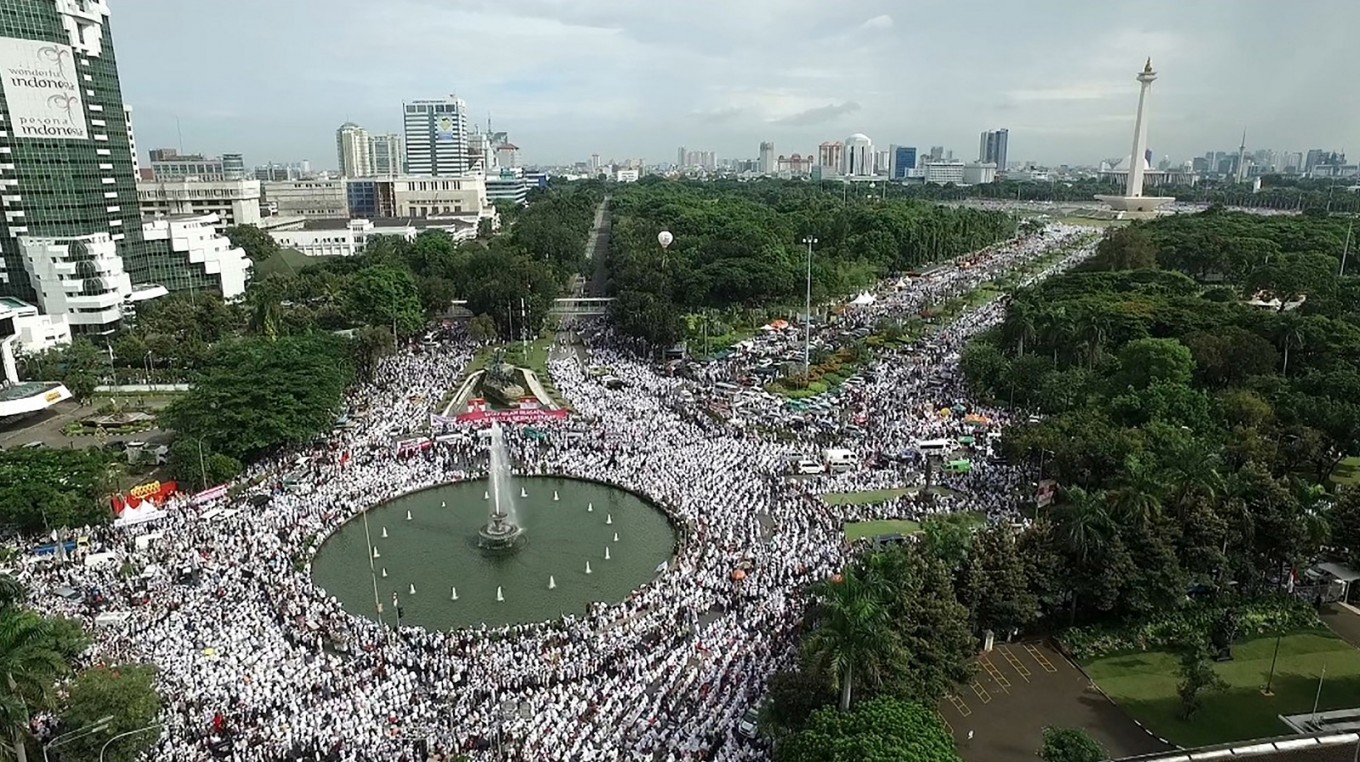
This aerial view shows Indonesian Muslims gathering at Jakarta's National Monument Park as part of a rally against Jakarta's Christian Governor Basuki Tjahaja Purnama, better known by his nickname Ahok, on December 2, 2016. More than 100,000 Indonesian Muslims protested on December 2 against Jakarta's Christian governor, the second major demonstration in a matter of weeks as conservative groups push for his arrest on accusations of insulting Islam. (AFP/File)

The above question is addressed to those who still believe in the strength of Indonesian Islam post-Jakarta gubernatorial election and the verdict of two years’ imprisonment handed down to Basuki “Ahok” Tjahaja Purnama, the outgoing Jakarta governor.
Indonesian Islam refers to Islam that is progressive, moderate and respectful of the diversity of ethnicities, beliefs and cultures that support democracy in the country.
For many years, local and international observers have felt confident about the authority of Indonesian Islam. The mushrooming of Islamic conservatism and radicalism has not been considered threatening enough to shrink the dominance of moderate and inclusive Islam.
The dominant role of the largest Islamic organizations, Nahdathul Ulama (NU) and Muhammadiyah, in Muslim communities is often used as reason for this optimism. Is this thesis still valid?
Indonesian Islam has been socially and politically attempted and strived for by those who believe in compatibility between Islam and democracy.
However, many elements of Indonesian Islam are too self-confident about the long supremacy of Indonesian Islam.
The source of this conviction is often the history of Islam’s entry to this country. It is often said Islam in Indonesia is different from Islam in the Middle East owing to its historical process, which was not through war and bloodshed but through peaceful penetration.
Thus, many of us take for granted and feel satisfied that the progressive and moderate characteristics of Indonesian Islam would never be defeated by the different version of Islam in this country.
Such historical evidence is very important, however not enough to maintain and sustain Indonesian Islam. It is questionable and to some extent no longer relevant.
Now, Indonesian Islam has begun to lose ground on account of an aggressive counter from “the different version of Islam” — stemming from the tendency of especially urban folks demanding an Islam that is more ideological, formalistic and operational in politics. More Indonesian Muslims want Islam as their main identity in politics, culture and lifestyle.
This tendency had been detected long before the 2017 Jakarta gubernatorial election, although many of us apparently ignored it. Many attempts at “sharia-zation” (inclusion of sharia in the legal, political and public sphere) has run systematically and strategically since the Reform Era.
When attempts aimed to make Indonesia a sharia-based state failed in 2002, the strategy of the sharia movement turned into a cultural movement, by conditioning Indonesian Muslims to embrace more sharia-inspired lifestyles such as halal economics and consumption.
Indonesia now has the 2014 law on halal product assurance as well as the 2008 law on sharia banking.
The halal and sharia economic movement is a step further toward the establishment of sharia as the legal and political system. Its propagators use a direct connection strategy to the grass roots, including through social media.
Its messages stimulate emotions of being Muslim, including the social gap and injustice experienced by many Muslims.
At a different level, the propagators of Indonesian Islam are not really aware of and to some extent dismiss this new environment and contestation in coining the meaning of Islam. Such “progressive” Muslims seem to be ignorant and overconfident.
The NU and Muhammadiyah, which are expected to be bastions of moderate Indonesian Islam, have been too busy bargaining for power in the government, and care less for their communities.
In addition, both organizations rely heavily on the state for being the guardians of sustainability of democracy and benign Islam.
Sometimes, the NU is very critical of the antidemocratic movement, but theirs are often lone voices. In short, the consolidation of Indonesian Islam tends to indicate their failure.
Interestingly, those who need “more formalistic, ideological and political Islam” are intensively mingled with populist issues. They have shown adequate flexibility to blend their campaigns with issues of social and economic injustice.
Although religious sentiment remains very important for their movement, the groups have indicated their ability to consolidate networks and to gain a stronger grip on the Muslim grass roots.
Combining populism with identity based politics has been very successful, as indicated by two results; first, the loss of Ahok-Djarot Saiful Hidayat in the recent Jakarta election and second, their pressure on Ahok’s trial that resulted in a two-year sentence for blasphemy.
What should be done by Indonesian Islam to overcome this circumstance?
Indonesian Islam should not mimic the strategy used by those who believe in Islamic formalism, ideology and politics.
For instance, using populism as the tagline of its struggle would lead to tyranny by the majority. Indonesian Islam instead aims for reduced segregation between the majority and minority.
Indonesian Islam should not use identity politics because doing so could lead to discrimination. Unfortunately, reflecting on the recent Jakarta gubernatorial election, today’s Indonesian Muslims in general seem to love both populism and identity politics.
In fact, Ahok’s case has stimulated the sentiment of Islamic populism and identity politics. Indonesian Muslims who have been recognized as open and tolerant are becoming more ethnic and religion-oriented.
If Indonesian Islam does not want to fail in mainstreaming its religious discourse, it must find ideas and idioms that can regain cleverly and responsibly the support of Indonesian Muslims.
If not, the notion that Indonesian Islam is too big to fail is just a claim.
Disclaimer: The opinions expressed in this article are those of the author and do not reflect the official stance of The Jakarta Post.

https://www.thejakartapost.com/academia/2017/06/09/is-indonesian-islam-too-big-to-fail.html

Tuesday, November 20, 2018

Thursday, November 8, 2018

Kasman Singodimejo: Santri Nasionalis Berkemajuan

Kasman Singodimejo: Santri Nasionalis Berkemajuan


Dār al-‘Ahd wa al-Shahādah: Muhammadiyah’s Contemporary Ijtihād of Siyar and Pancasila

Bachtiar, Hasnan. 2018. Dār al-‘Ahd wa al-Shahādah: Muhammadiyah’s Contemporary Ijtihād of Siyar and Pancasila. MA Thesis, College of Arts and Social Sciences, The Australian National University.

Abstract

This thesis examines the concept of Siyar that has been developed by Muhammadiyah, especially in the context of nation-state, globalisation, and the post-9/11 and post- reformation era of Indonesia. In 2015, Muhammadiyah proclaimed the notion of Negara Pancasila sebagai Dār al-‘Ahd wa al-Shahādah, which means the state of Pancasila as the state of consensus and witness, as a representation of the Siyar. This thesis fills three gaps of study: first, Siyar, which has been developed in the Arab- Islamic traditions, has not been studied in the context of Southeast Asia, and especially Indonesia, a non-Arab country with the largest Muslim population; second, academic works on the specific topic of Muhammadiyah produced in Western universities have not discussed the Muhammadiyah’s view of Siyar; and third, the studies that have focused on Siyar have not yet dealt with discourse on contemporary Indonesian politics and especially Muhammadiyah’s place in it.

This thesis combines library research, and social and historical contextualisation. This combination relies on primary sources consisting of official documents of Muhammadiyah, academic and intellectual works of its elites and research publications, and secondary sources that consist of scholarly works on the specific issue of the Muhammadiyah conceptualisation under study. This analysis is supported by interviews with key persons in Muhammadiyah elites who have contributed to the development of the notion of Negara Pancasila sebagai Dār al-‘Ahd wa al-Shahādah.

The thesis finds that Muhammadiyah conceptualises the notion of Negara Pancasila sebagai Dār al-‘Ahd wa al-Shahādah as an intellectual reconciliation between the state ideology of Pancasila and the doctrine of Siyar. This notion is based on its fundamental basis of thought called Islam Berkemajuan (progressive Islam), whereby Islam should be viewed progressively as a problem-solving religion. This effort, in Muhammadiyah’s perspective, is ijtihād which primarily aims to solve the problem of the significant spread of conservative and radical Islamism. In its view, this problem can potentially lead to national disintegration since the Islamists have questioned the status of Indonesia as a state (because it is not dar al-Islam or an Islamic state) and its political system (it is not a Sharī‘ah system). In this context, Muhammadiyah argues that Indonesia is the state based on Pancasila (Negara Pancasila), and since Pancasila was conceptualised through the national consensus by its founding fathers, Indonesia should be understood as the state of consensus (dār al-‘ahd) – that is, neither the Islamic state nor the state of war. 

Through this argument, Muhammadiyah emphasises that it supports a moderate Islamic concept of democracy. Accordingly, it adds the concept of dār al-shahādah (the state of witness) which suggests that all Indonesians should become witnesses to the development of Indonesian civilisation. Its approach of ijtihād – ‘theologising democracy’ – proposes developing democracy as a paradigm built on a theological interpretation of Islam that emphasises the importance of values such as shūra (people’s sovereignty or consultation) and ‘adālah (justice), among others. It is, in this way, viewed as having potential for the future development of interreligious relationships and as a model for the ‘dynamisation’ of Islamic law.